Compassion versus self-preservation
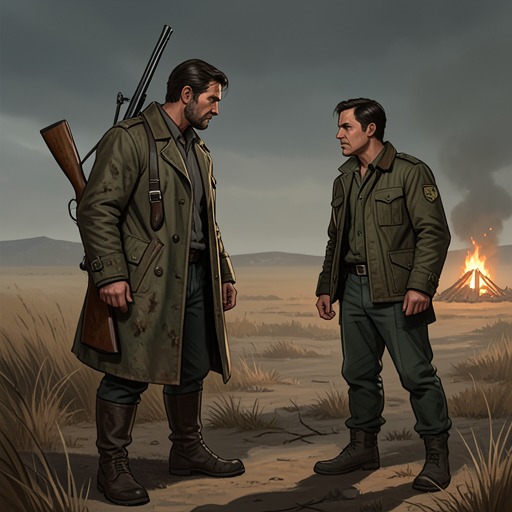
The Dog StarsCompassion versus self-preservation is a practical and moral tension in the survivors’ world: caution can preserve life, but strict separation can also leave vulnerable people without help. The contrast runs from Hig and Bangley’s concealed, heavily armed approach to danger to Cima’s willingness to cross a quarantine boundary and care for the Mennonite community. Neither choice erases the risk; together, they show how survival depends on both defense and connection.
Survival as a Tactical Discipline
Hig’s approach to the airport tower makes self-preservation concrete. With Pops, he moves around the south side of a building while staying out of the tower’s view. Before crossing an exposed ramp toward the FBO offices, they stop roughly fifty yards from the next building. Hig has unsnapped his AR-15, taken the Handheld radio, tuned it to 118.1, and retrieved Bangley’s grenades from beneath a lamb. The equipment is ready, but the pair still relies on concealment and timing rather than rushing into the open.
Hig considers the possibility of speaking to an enemy, while also recalling Bangley’s lessons in reticence and overwhelming firepower. That combination matters: communication is not treated as a dependable route to safety, and force is not treated as a reason to abandon caution. The encounter’s physical arrangement—the hidden approach, the pause before the ramp, the unseen tower—turns survival into a sequence of decisions about when to remain silent, when to expose oneself, and what protection to carry.
The Vulnerable on the Other Side
The question of what happens to survivors after an attack shifts the emphasis from tactical danger to the people made vulnerable by it. Hig asks what hostile survivors do with those who emerge from wreckage. Bangley answers that attackers may pick them off one by one or take them for purposes that remain unspecified. His account presents the survivors not as a single, abstract threat but as injured and disoriented people who can themselves become targets.
Bangley’s response is also anger, not detached calculation. The exchange does not show him setting aside his defensive outlook or establishing a new rule for dealing with survivors. Instead, it makes visible a pressure within that outlook: knowing how attackers prey on the vulnerable can provoke outrage, even when the prevailing logic remains one of caution and force. Hig’s question keeps attention on the human consequences of the violence, while the answer offers no assurance that compassion alone can protect anyone from it.
Cima Crosses the Quarantine Boundary
Cima’s visit to the Mennonite community gives the tension a different form. After Hig lands with Pops, Cima wants to go to the families and brings her medic bag. They land in the farmhouse drive, where people have gathered along the quarantine line. Their wary expressions change as Cima approaches. She steps across the DMZ; the group initially makes room, then closes around her. Children reach for her skirt, and she greets them and asks their names. Hig watches their apprehension give way to welcome.
The crossing is not made in ignorance of danger. Hig is worried, and Cima knows the families are contagious. But she tells him that the boundary rests on a mistaken understanding of how the illness spreads. In the farmhouse parlor, she puts on latex gloves and examines the people who come to her. She treats wounds, calls for warm water, advises a pregnant woman, and comforts an older man whose distress can be heard outside the kitchen. Her care is specific and sustained: the decision to cross the line becomes hours of medical attention rather than a symbolic gesture alone.
Protection, Misunderstanding, and the Cost of Care
Cima explains that transmission requires contact with blood or other bodily fluids, comparing the misunderstanding to earlier fears around Hep C and HIV. The quarantine has therefore been both misinformed and protective. The warning signs at the edges of the fields have frightened attackers away, helping preserve the community even as illness has weakened its members. The same separation that has kept danger at a distance has also made ordinary contact seem forbidden.
Hig’s account holds both consequences in view. He is almost willing to accept whatever may follow simply to witness the scene of Cima being welcomed and touched by people who had been treated as untouchable. That response does not prove the danger has disappeared; the two fly back in silence. Rather, the visit shows what self-protection can exclude, and what compassion can make possible without making risk vanish. The episode’s force lies in that unresolved balance: caution guards the living, while care insists that survival also involves reaching across the distance fear has created.